
Signs You’ve Found a Good Painter (and How to Spot the Cowboys)
By Nicole Howell, co-owner, Bay Decorating · Last updated 26 May 2026
How do you tell a good painter from a cowboy? A good painter talks more about preparation than paint, gives you an itemised written quote that names the products and the number of coats, shows you real jobs from the last few years, and turns up when they say they will. A cowboy competes on being cheap and fast, and cuts the prep you can't see.
I'm Nicole. I co-own Bay Decorating with my husband Tim, here in Napier, and I write every quote and check every job we do. Hiring a painter shouldn't feel like a gamble, but I understand why it does. Most people have heard the horror stories: paint peeling inside a year, patchy walls, the painter who vanishes once the deposit clears.
The hard part is that the difference between a good job and a bad one is mostly hidden. It's in the prep, under the paint, where you can't see it until it starts failing two years later. So here's what actually separates a good painter from a cowboy in Hawke's Bay, and how to tell which one is standing in your driveway before you hand over a cent.
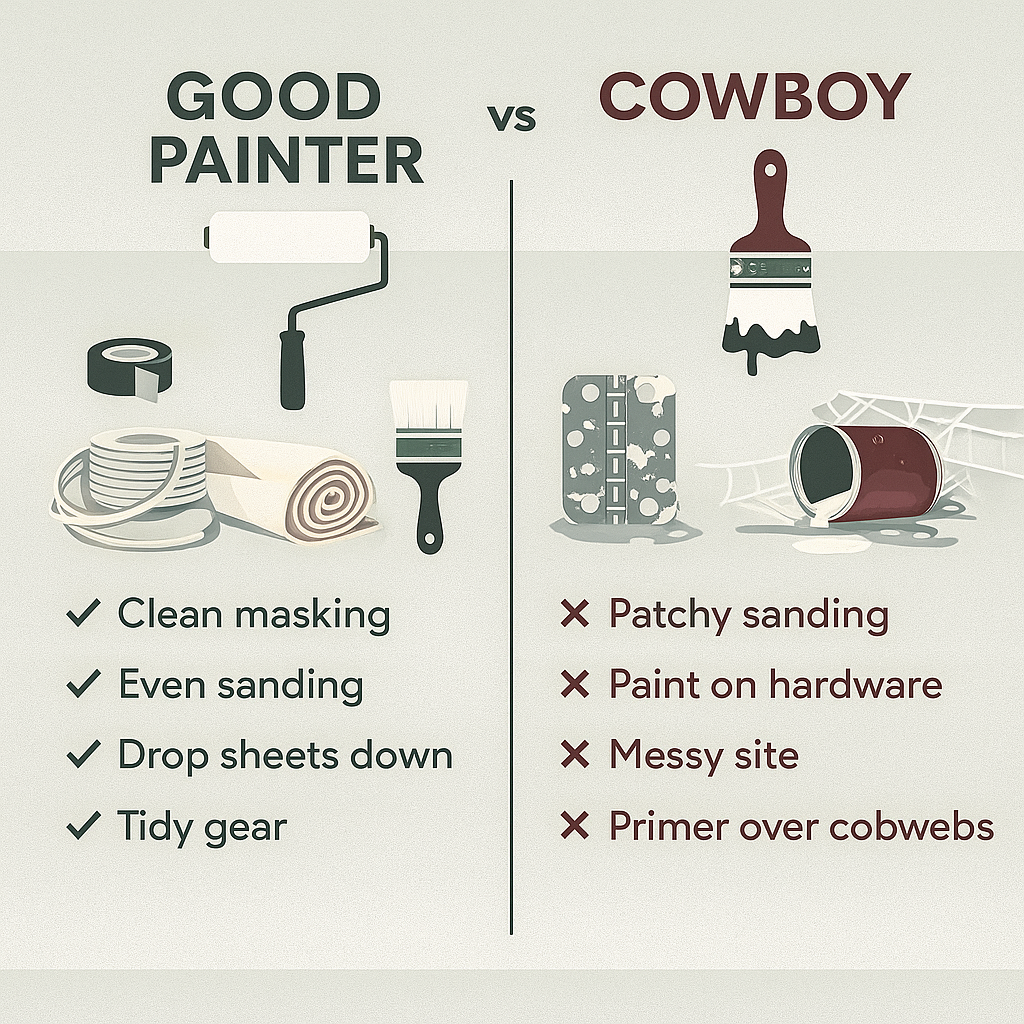
What's the difference between a good painter and a cowboy?
The difference isn't visible on day one. Almost any paint looks fine when it's wet. It shows up in five or ten years, and it comes down to one thing: a good painter is building a reputation. A cowboy just wants the deposit cleared.
A good painter follows a clear process, takes their time on the parts you'll never see, and is upfront about what your house actually needs. They protect your home while they work and leave it tidy at the end of each day. Our lead painter Jesse describes a villa repaint as "turning something that's so old and haggard into something beautiful again" — that mindset is what shows up in the finish.
Cowboys rely on being cheap and fast. They skip the prep, paint over dust, mould or flaking paint, and hope you don't notice until they're long gone. I once watched another painter in Napier priming straight over cobwebs and mould because they "just wanted to get it done." That paint started peeling within months. A cowboy will spray it all on, do minimal prep, not wash it down, not treat the moss and mould, not fill anything, and it falls apart in two years.
A cheap job almost always costs more, because you end up paying to have it done again.
Why there's no painter's licence in New Zealand — and what to check instead
In New Zealand, anyone can call themselves a painter. There's no licence, no register, and no minimum qualification required by law. That's the single most important thing to understand before you hire one.
Compare that with the trades that can physically hurt you. Electricians, plumbers, gasfitters and drainlayers are all restricted by law — only registered people can legally do the work. Painting has no equivalent. The trade that can quietly cost you tens of thousands in redone work is the one with the open door.
That's not a reason to panic. Most painters are honest and good at their job. It just means the responsibility to check sits with you, and a register won't do it for you. There is a real qualification — the New Zealand Certificate in Painting and Decorating, earned through an apprenticeship — but it's optional, and plenty of excellent painters came up without the paperwork.
So what actually tells you someone's the real deal?
They've got a real reputation, and they'll show it. This is the big one. Ask around — word of mouth is still the best test there is. Talk to people who've had them in, look for Google reviews that have built up over time (and read what people actually say, not just the star count), and ask if you can go and look at a job they've done. A good painter will happily point you to a place you can at least drive past, or put you in touch with the owner for a proper look. If they go quiet when you ask, that tells you something too. Years of steady local work and genuine reviews are far harder to fake than a slick website.
They're GST-registered. A painter working full-time will almost always turn over more than $60,000 a year, which means they have to register for GST. A "cash only, no GST" quote usually means a part-timer, or someone who'll leave you with no tax invoice and no paper trail if anything goes wrong.
They carry public liability insurance. Ask to see it. It costs a legitimate painter real money each year, and it covers you if something gets damaged.
Accreditations are a bonus, not the whole story. Some painters are Master Painters members or Dulux Accredited. Those are genuine signals — a Master Painters member has been in business a while, had recent jobs inspected, and offers a workmanship guarantee. But membership is voluntary, plenty of excellent painters aren't members, and no badge is a substitute for looking at the actual work.
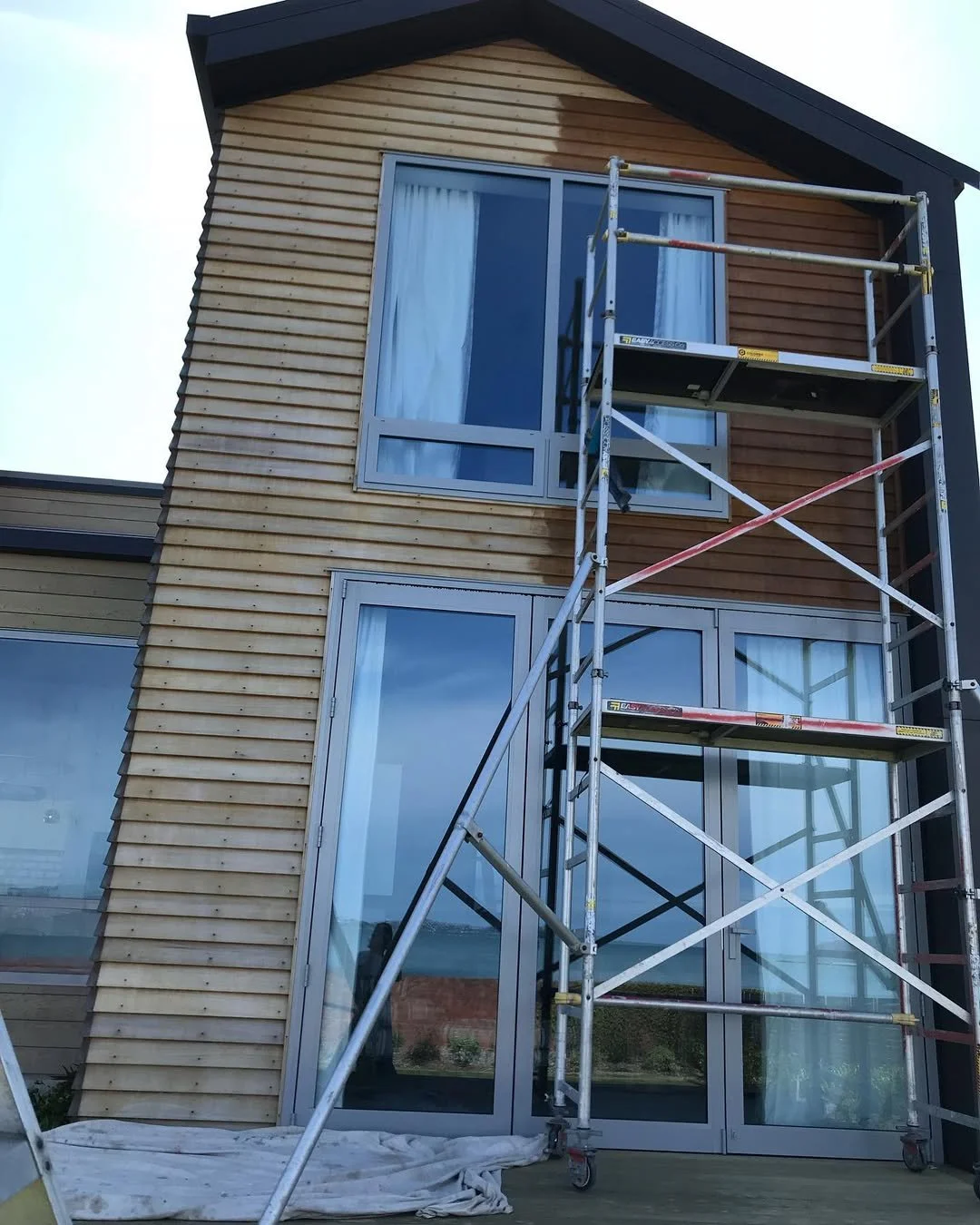
Proper scaffolding in use when staining this cedar house exterior.
How to read a painter's quote
A good quote spells out the work, not just the price. It should name what's being washed, sanded, filled and primed, how many coats go on, which paint is being used, and what's included or left out. If a quote is a single line — "Exterior repaint, $X" — you have no way of knowing what you're actually buying.
Two quotes for "the same job" can be thousands of dollars apart, and it's usually because they aren't the same job at all. A vague line like "paint to cover" lets a painter walk around your house and decide, wall by wall, "this side doesn't look too bad, one coat will do." A proper quote says "two full coats" in writing. Lay your quotes side by side and read them line by line, not bottom figure to bottom figure. We dig into why two prices can differ so much in the real difference between a $10k and a $20k paint job.
A few things a good quote makes clear:
The paint, by name, grade and finish. The same brand usually sells a budget line and a premium line. The brand on its own isn't enough — which product, and why that one for your house.
How many coats, and whether they're going over a separate primer or sealer where the surface needs it.
Who supplies the paint, and who's actually doing the work. The person who quotes isn't always the person who paints.
What happens if something unexpected turns up. On an older home you don't always know what's under the old paint until you start. Agree up front how surprises get handled, so a "variation" doesn't land as a shock on the final invoice. If it isn't in writing, it doesn't exist.
We quote with line items rather than one lump sum — windows, weatherboards, eaves and fascia, and water blasting are all broken out separately, so you can see exactly what you're paying for. We even list re-puttying timber windows — resealing the old, cracked putty that holds the glass in — as its own line. A lot of painters leave it off the quote, so it either gets skipped (and water creeps in behind the glass) or shows up later as an extra. The paint is always included in our price too.
On deposits: Consumer Protection's advice in New Zealand is to pay 10% or less up front, get a receipt, and never pay in full before the work's done. Pay by a traceable method rather than cash, so there's a record if anything is ever disputed.
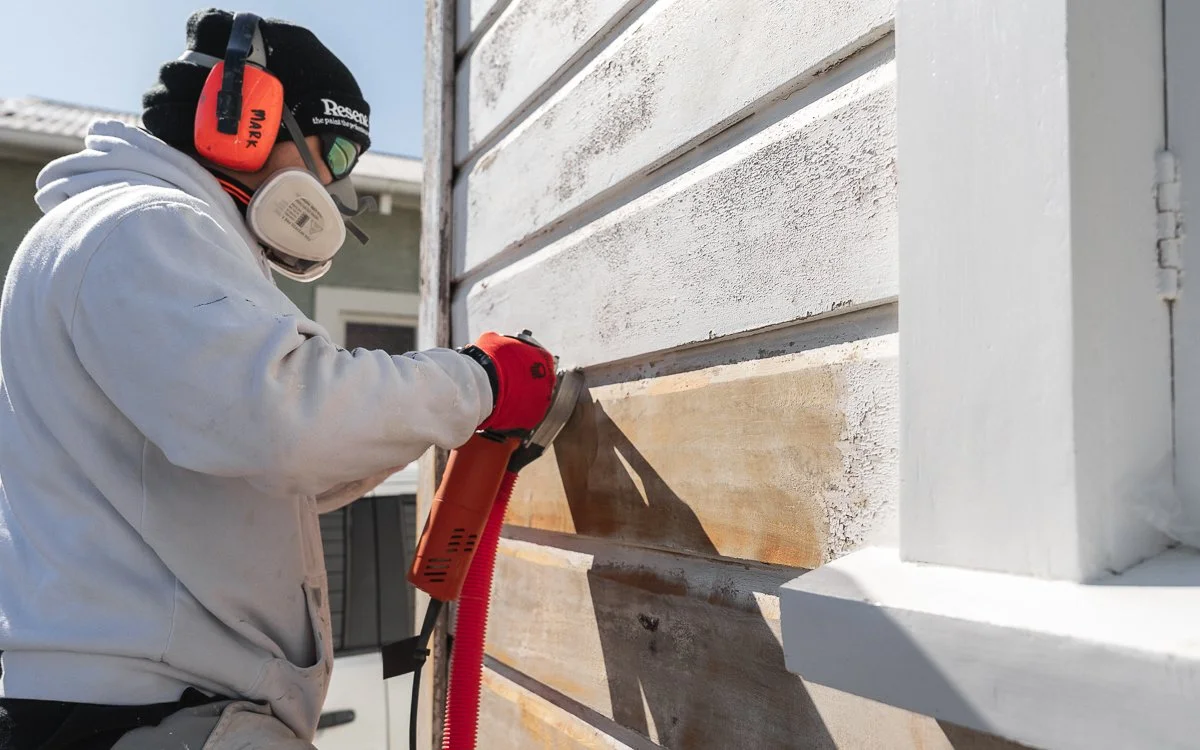
Jesse using a specialist paint shaving tool to remove lead based paint from a villa exterior.
What does good prep actually look like?
Good prep means dealing with everything under the paint before any colour goes on: washing, treating mould, scraping and sanding back failing paint, filling, and priming bare timber. On most exteriors, prep is around 70% of the job and painting is the other 30%. It's the part you can't see once it's finished, and it's the part that decides how long the job lasts. (Our guide to proper paint prep walks through it in full.)
A proper exterior prep runs in order: wash the house down, treat any moss and mould (water blasting alone doesn't kill the spores), scrape off loose paint, sand or strip back, prime any bare timber, fill and seal gaps, then topcoat. Skip a step and you've bought a year or two before it lifts.
A couple of things you can check yourself:
The chalk-rub test. Rub your hand over the painted weatherboards. If it comes away chalky, the old paint is breaking down, and new paint won't grip properly unless the surface is cleaned back and sealed first. A cowboy just paints over it.
Exterior paint doesn't prime itself. Some interior paints have a primer built in; exterior systems generally need a separate sealer on bare or chalky timber. If a quote for a weathered house doesn't mention a primer or sealer anywhere, ask why.
Our own rule of thumb: once around 40% of the old paint is flaking, the system has failed and the surface needs to come back to bare timber rather than be patched over. We'll say so and re-quote, rather than paint over a problem and watch it lift again.
Lead paint deserves its own mention. Homes built before the 1980s often have lead-based paint underneath, and you can't just sand it — that throws lead dust through the house and garden. It has to be contained and removed properly. We use a paint shaver, a grinder with a vacuum head that strips old boards with very little dust escaping. If your home is of that era, ask a painter how they'll handle it. "We'll give it a sand" is the wrong answer.
How can you tell the paint will actually last?
Ask the painter how long they expect the job to last, and listen for an honest answer tied to the condition of your house — not a blanket "ten years" for everything. In Hawke's Bay, a well-prepped exterior in good condition should give you 7–10 years inland, and closer to five near the coast, where sun and salt are harder on paint. (How often should you repaint in Hawke's Bay? goes deeper on the signs.)
A good painter sets that expectation up front. We use Resene's CS1–CS4 condition scale — a standard rating for how sound the existing surface is — to do exactly that. A near-new surface (CS1) can give you ten years. A poor, badly exposed one (CS4) might only give three or four, no matter how good the paint is. We had a villa on Kennedy Road so far gone that I set a three-year expectation with the owners before we started, rather than promise something the timber simply couldn't hold.
A painter who promises the same lifespan for every house, whatever shape it's in, either doesn't know or doesn't want to tell you.
One test costs you nothing: ask to see a job they painted five years ago. If it still looks sharp and even, you've found someone who does it properly.
Signs of quality work once the job's underway
Once a painter is on site, the tells are simple. They turn up when they said, keep the site tidy, mask and protect carefully, and the same crew that started the job is the one finishing it. Sloppiness on the surface usually means shortcuts underneath.
What good looks like day to day:
They turn up when they say. We're on site when we say we'll be. Clients often tell us they're surprised, because they're used to waiting 15 or 20 minutes for trades to pitch up.
The same faces, start to finish. Ask whether the people quoting are the people painting, and whether they use a regular crew or bring in unknown subcontractors when they're busy. Subcontractor churn in peak season is where consistency falls apart. Our crew is the same small team throughout — Tim and me, Jesse, Cherie and Zane — not a rotating cast.
A tidy site. Drop sheets down, gear stored where you agreed, dust managed during sanding, and a pack-down at the end of each day. Many of our clients live in the house while we work, so we treat it like a home, not a building site.
Clean workmanship. Straight cut-in lines — the crisp edge where a wall meets the trim — plus no drips or roller marks, an even sheen, and no paint on hinges, handles or window glass. A messy finish on the parts you can see tells you how much care went into the parts you can't.
Questions to ask before you hire a painter
The best questions force a painter to be specific. Vague answers — about prep, paint, or who's doing the work — are the warning sign. Here's a short list worth putting to every painter who quotes your job.
Before you hire:
What prep is included in this quote, and what happens if you find more once you start?
What paint are you using — brand, grade and finish — and how many coats?
Who'll actually be doing the work, and is it the same crew start to finish?
Can I see a job you did three to five years ago?
How long do you expect this to last on my house, and why?
Are you GST-registered, and do you carry public liability insurance?
While the job's underway:
Are they sanding and prepping properly, not just spot-patching the worst bits?
Is the site tidy, and is the gear in good order?
Are they masking edges and cleaning up as they go?
When it's finished:
Check the trims, corners and cut-in lines for clean, straight edges.
Look for even coverage, with no thin patches or visible brush strokes.
Ask what happens if something needs touching up later. A good painter would rather fix a small thing early than leave you unhappy.
A good painter will have answered half of these before you even ask. Honestly, a lot of it comes down to the person who turns up to quote — if you feel you can trust them, that tells you most of what you need to know.
Why Hawke's Bay homeowners choose Bay Decorating
We've built Bay Decorating on being the painters you'd actually want in your home — we turn up when we say, and we do the prep properly so the job lasts. Most of our work comes from builder referrals and repeat clients, which only happens if the last job held up.
What that looks like in practice:
A team that's actually done the work. Jesse has around 17 years on the tools and specialises in exteriors and villa restoration; Cherie brings about 18 years and a fine eye for heritage detail; Tim trained on big heritage villas in Wellington; Zane was schooled hard on prep before anything else. I handle the quoting and check every job myself.
Quotes you can actually read. Every quote is itemised, the paint's included, and re-puttying timber windows is a line item, not a surprise.
Prep done properly. Wash, treat, sand or strip, fill, prime, then paint — and we'll tell you honestly where your house sits on the Resene condition scale before you spend a cent.
The right gear. Our paint shaver lets us strip old, lead-painted weatherboards back safely with very little dust. Not every painter has invested in that.
A local reputation we protect. Five-star Google reviews, a place in the BNI Hastings chapter, and a network of Hawke's Bay builders, plumbers and rot-repair specialists we work alongside.
We don't want to be called back in a few years because something we painted has failed — happy clients are where the next job comes from. Whether it's a new build or a 100-year-old villa, that's the standard we work to. You can see more of our work on our villa and heritage painting page.
Most of the horror stories we get called into are interior jobs — someone's cut corners on prep in a room the owners have to live in. If that's what you're after, here's how we approach interior painting in Napier.
Frequently asked questions
-
Look for three things before anything else: an itemised written quote that names the paint and the number of coats, real photos or addresses of jobs from the last few years, and a painter who talks more about preparation than colour. Those three together are much harder to fake than a tidy website or a low price.
-
No. Unlike electricians, plumbers and gasfitters, painters don't need a licence or registration to work in New Zealand — anyone can call themselves one. A formal qualification exists (the New Zealand Certificate in Painting and Decorating), but it's optional. That's why references, recent work and a detailed quote matter more here than any badge.
-
Consumer Protection NZ advises paying a deposit of 10% or less, getting a receipt, and never paying in full before the work is finished. Pay by a traceable method rather than cash so there's a record. A painter demanding a large deposit up front is a red flag.
-
Usually because it isn't quoting the same work. The cheap one often means fewer coats, less prep, or a budget paint — the parts you can't see on day one. Paint itself is only a small slice of the total cost, so a quote that saves money there is saving it in the wrong place. Compare what each quote actually covers, line by line.
-
Ask what prep is included, what paint they're using and how many coats, who's doing the work and whether it's the same crew throughout, whether you can see a recent job, and how long they expect it to last on your house. A good painter answers these readily and specifically.
-
Proper prep means washing, treating mould, sanding or stripping failing paint, filling, and priming bare timber before painting — around 70% of the work on an exterior. A quick check: rub your hand on the old paint; if it comes away chalky, the surface needs cleaning back and sealing, not just a fresh coat over the top.
-
Not always. Homes built before the 1980s often have lead-based paint, which can't be sanded safely because it releases lead dust. It needs to be contained and removed properly, with the right gear. If a painter plans to dry-sand old paintwork on a pre-1980s home without mentioning lead, that's a concern.
-
A well-prepped exterior in good condition should last around 7–10 years inland, and closer to five near the coast, where sun and salt wear paint faster. Good prep and quality paint can roughly double the life of a job compared with a quick once-over.
-
Three is a good number. It gives you a feel for the fair price and lets you compare what's actually included. Be wary of both the cheapest and the dearest until you've read what each one covers — the best value is rarely the lowest number.
Getting a quote
Choosing a painter comes down to trusting the person who'll be at your place for a week or two to do the bits you'll never see — the cheapest number rarely tells you that. If you'd like a quote that lays everything out line by line, for your home in Napier, Hastings or Havelock North, give us a call. We're always happy to walk you through what your house actually needs — and what it doesn't.

Author: Nicole Howell — Co-owner, Bay Decorating
I co-own Bay Decorating with my husband Tim, here in Napier. I look after the quoting, the site visits, and the quality check on every job, so I'm usually the person you'll deal with from your first quote through to the final once-over. The thing I care about most is clear, no-jargon communication. I've been the homeowner stung by a renovation that ran thousands over budget, and I never want a client of ours to feel that. These articles are me passing on what actually goes into a good paint job in Hawke's Bay.