
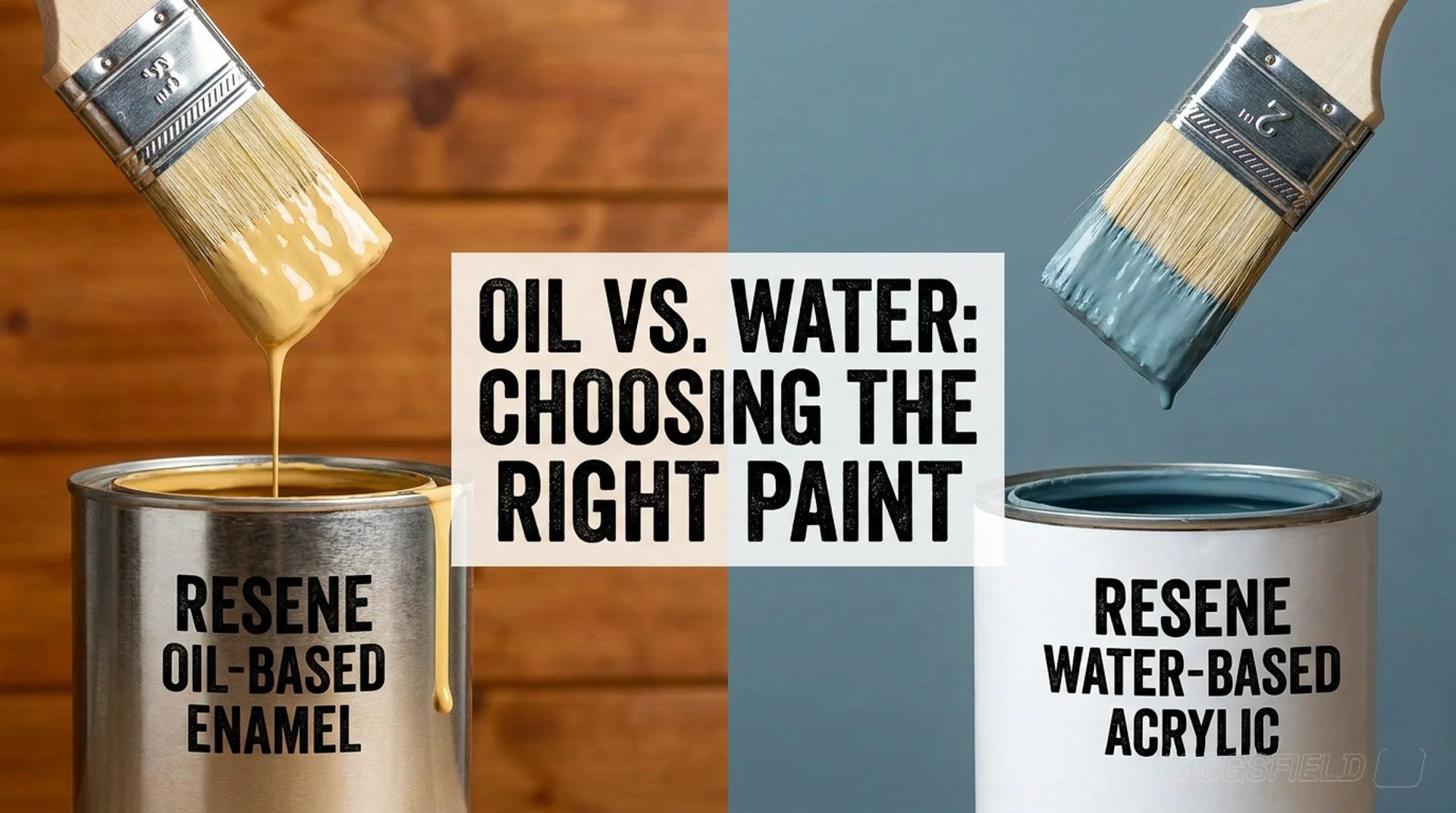
Most of the paint questions I get on a quote come down to this: water-based paint belongs on nearly everything in a New Zealand home — walls, ceilings, exterior weatherboards. Oil-based earns its keep as a primer, on the surfaces that cause trouble: timber that bleeds its own colour up through the paint, or a wall that's just been skimmed with fresh plaster. What you can't do is pick either one until you know what's already on the wall. That's the bit people skip.
People want to know why the last coat peeled, or whether they can just go over what's already there. So I'll start with how to find out what you've got — it takes about two minutes and a bottle of meths — then walk through what each answer means for your repaint, inside and out.
I'm Nicole. I co-own Bay Decorating with my husband Tim, here in Napier, and I do the quoting and the quality check on every job we run around Hawke's Bay. So this is the stuff I end up explaining on doorsteps most weeks.
What's the difference between oil and water-based paint?
The short version: water-based (acrylic) paint dries fast, has very little smell, stays flexible and holds its colour. Oil-based (enamel) paint dries slow and rock-hard, smells strongly while it cures, and yellows over time. Neither is simply better than the other. The right one depends on the surface, and on what's already sitting on it.
| Water-based (acrylic) | Oil-based (enamel) | |
|---|---|---|
| Dry time | Fast, often recoatable the same day | Slow, usually overnight between coats |
| Smell and fumes | Low odour, low solvent | Strong solvent smell |
| Flexibility | Stays flexible, moves with the timber | Dries hard, goes brittle over the years |
| Colour over time | Holds its colour, stays white | Ambers and yellows, worse away from sunlight |
| Cleanup | Soap and water | Turps |
| Where it earns its place | Most walls, ceilings and exterior weatherboards | Primers on problem surfaces, some enamel work |
Water-based paint has quietly taken over most jobs in New Zealand, mainly because it's lower in odour and solvents and far nicer to live with while the work's happening. That matters more than people expect when you're staying in the house through a repaint, sleeping in a room that was painted that afternoon. But oil hasn't gone anywhere.
How to tell if your paint is oil or water-based
Rub methylated spirits on the paint with a clean white rag. If colour lifts onto the rag and the surface feels soft, it's water-based (acrylic). If the rag stays clean and the paint stays hard and glossy, it's oil-based (enamel). That's the whole test.
Do it properly and you'll trust the result:
- Pick a spot no one will notice: inside a wardrobe, behind a door, or a low corner of a weatherboard.
- Dampen a clean white rag with meths (methylated spirits from the supermarket or hardware shop). It's flammable, so crack a window if you're inside and keep it away from anything with a flame or pilot light.
- Rub the same spot firmly for ten or fifteen seconds.
- Read the rag. Colour on the rag and a softened surface means water-based. A clean rag and a hard finish means oil-based.
One thing before you trust it: the reaction varies with gloss level and colour, not just with paint type. A high-gloss finish resists solvent more than a flat one whatever it's made of, so on very glossy paint give it a bit longer and test a second spot before you call it.
There's another tell that helps confirm it. Old oil enamel is usually glossier and harder than acrylic, and outside it often goes chalky, leaving a fine powder on your hand when you run it down a weatherboard. Chalking on its own isn't proof, though. Water-based paint chalks too, especially in darker colours on the walls that cop the most sun. Treat it as a supporting clue and let the meths test give you the answer.
This tells you what's on the surface now. Plenty of Hawke's Bay houses have been repainted over the years, so there can be older, different layers underneath, and that's the sort of thing we check properly on a site visit.
Why bother? Because the paint you can safely put on next depends entirely on this answer. Going water over oil is a completely different job from going like-for-like, and getting it wrong is exactly how a fresh coat ends up peeling inside a year.
What your test result means for repainting
If your test says water-based and the surface is sound, you're in the easy lane: a clean, a light sand and a quality acrylic topcoat. If it says oil-based, you've got a decision to make — stay oil, switch to water-based with the right prep underneath it, or strip it back if the old system is failing and not just aged.
Like-for-like, the same type of paint going back over itself, is always the simplest repaint. That's why the water-based result is the easy one.
Oil-based takes more thought. Staying oil is straightforward, and over a sound surface a compatible enamel goes back over the top. Switching to water-based is where people come unstuck: that surface needs a light sand to kill the gloss, a proper clean, and an adhesion undercoat before the topcoat goes anywhere near it. And if the paint is failing, not just old, neither of those applies. Strip it. No primer rescues a coating that has already let go.
That last one is where proper prep earns its keep, because most paint that fails early doesn't fail on the topcoat. It fails on what was, or wasn't, done underneath. When a surface is mostly flaking, the old system has essentially let go. Patching over that eats more time than a proper strip-back saves, so stripping it right back is the honest call, and it's a big part of what a repaint costs.
Should you use oil or water-based paint on exterior weatherboards?
For weatherboards and most exterior timber, a quality water-based topcoat is what we reach for, and it's the bulk of our exterior painting work. It stays flexible and moves with the timber as it swells and shrinks through the seasons, and it copes with sun and salt better than an old oil finish that's gone hard. Bare timber and any problem spots get the right primer first.
The rest of the outside isn't all the same job, though. Window joinery and fascia take more knocks and weather, so they get a harder-wearing finish, which modern water-based enamels now do well. Metal needs its own primer before any topcoat — on galvanised spouting and flashings we use Resene Galvo One, which bonds to the zinc. And a deck needs its own coating, not a wall paint. Water sits on a flat surface instead of running off, so it works under a paint film and lifts it.
Oil or water-based for trim, doors and skirting?
Use a water-based enamel. Trim, doors and skirting were traditionally oil enamel's home, because people liked the hard, glossy finish, but modern water-based enamels give you that same look without the strong smell, and without the yellowing oil brings to a white skirting, especially in a hallway or a room that doesn't get much sun. It's what we reach for on most of our interior painting.
How do you stop stains bleeding through paint?
You need a pigmented sealer, and for most stains that means a solvent-based one. Water stains from an old leak, smoke damage, marker and crayon, and tannin bleeding out of timber all share the same problem: they're soluble, so an ordinary topcoat just lets them travel up through. A pigmented sealer blocks them off. Resene's Sureseal is the one we reach for. Two things to flag, though. One coat won't hold back heavy staining, and no sealer fixes the cause, so if the stain came from a leak, the leak gets sorted first.
Timber tannins are the version of this most people meet. Some timbers carry tannins, and tannins are why a beautiful job can go wrong months later. Put a water-based primer straight onto that kind of timber and the tannins leach up through the paint and yellow it, so your finished ceiling ends up looking like it's been stained with smoke. An oil primer seals the tannins off so they can't bleed. We did a set of vaulted feature beams where the timber was tannin-rich, so we primed them with an oil-based primer before the topcoats. The same thinking applies to tannin-rich timber outside, like cedar, and to the character timber you meet on older villas, which is where a lot of our care goes.
Why does paint bubble on a stripped or skim-coated wall?
Old wallpaper paste left in the plaster pulls the moisture out of a water-based coat, and the paint lifts and bubbles. The fix is to sand it back and oil-prime first, then topcoat over that. I learned this one in my own hallway. We'd stripped the wallpaper off, skim-coated the walls (a thin layer of fresh plaster over the whole surface), and painted them in water-based like everywhere else, and those were the only walls in the house that bubbled.
There's a proper system for a stripped-and-skimmed wall, and it's the one Resene specify. You strip the wallpaper, oil-prime, knock it back with sandpaper, oil-prime again, then skim coat. A water-based sealer goes over the skim, and then your topcoats. Two oil passes before the skim is the part people skip, and it's the part that stops you repainting the same wall twice.
Can you paint water-based over oil-based?
Yes, but never straight over the top. Oil-based paint cures hard and glossy, and a water-based coat has nothing to grip, so it peels. To switch a surface from oil to water-based you need to take the shine off with a light sand, clean it properly, and put down the right adhesion undercoat first — an undercoat made to grip a surface the topcoat can't hold onto by itself. Do that groundwork and a water-based topcoat sits down and holds for years. Skip it, and you've built the peel in from day one. When someone shows me paint sheeting off a door frame, this is usually the story behind it.
An oil-based primer is a different story from old oil paint, and this trips people up. The oil primers we use on tannin timber or a stripped-and-skimmed wall are made to be painted over, so a water-based topcoat goes straight over an oil-based primer with none of this drama. That's the whole reason they exist. The peeling problem is only ever about going over a cured, glossy oil finish that was never meant to be recoated without prep.
Can you paint oil-based over water-based?
Not straight over, either. This direction isn't the free pass people assume online. A hard enamel film sitting on a flexible acrylic one tends to crack as the surface moves through hot and cold, and Resene want their own enamel undercoat down first before you go that way. Two paint systems don't just stack, whichever order you try them in.
Not sure what you've got? That's what we're here for
If you've done the meths test and you're still not certain, that's completely normal, and it's exactly the kind of thing I sort out on a site visit. When we quote a repaint we check what's already on every surface, flag anything that needs stripping or an oil primer, and put it in writing so there are no surprises later. We'll even ring our Resene technical rep to confirm a tricky adhesion or bubbling call. Getting the paint right is the easy part once you know what's underneath.
If you'd like a hand, book a no-obligation site visit or quote and we'll tell you straight what your place needs.
Common questions about oil and water-based paint
How can I tell if my paint is oil or water-based? Rub a little methylated spirits on the paint with a clean white cloth. If colour comes off onto the cloth and the surface feels soft, it's water-based (acrylic). If the cloth stays clean and the paint stays hard and glossy, it's oil-based (enamel). Test a hidden spot first, like the inside of a wardrobe or behind a door.
Can you paint water-based over oil-based paint? Yes, but not straight over the top. Oil-based paint is hard and glossy, so a water-based coat won't grip it on its own and will peel. The surface needs a light sand to take the shine off, a proper clean, and the right adhesion undercoat first. Once that's done, a water-based topcoat holds fine.
Does oil or water-based paint last longer outside in NZ? For weatherboards and most exterior timber, a quality water-based topcoat generally lasts longer outdoors than oil. It stays flexible and moves with the timber, and it handles UV and salt air better, while oil dries hard and eventually goes brittle in the sun. Oil still earns its place as a primer on bare or tannin-rich timber. How long any system lasts comes down to prep and starting condition as much as the paint itself.
Why does my paint keep peeling or bubbling? Peeling and bubbling almost always trace back to what's underneath, not the paint you put on. Common causes are painting over a glossy oil surface without sanding and priming, moisture in the surface, or old wallpaper paste pulling moisture out of a fresh water-based coat. The fix is stripping back the failed area, sorting the surface, and priming it correctly before you topcoat.
Is oil-based paint being phased out? Water-based paints have taken over most interior and exterior work in New Zealand, mainly because they're lower in odour and solvents and better for the people living in the house. Oil-based products haven't disappeared, though. Oil primers and undercoats are still the right call on tannin-rich timber and some problem surfaces, and enamels still get used where a particular finish is wanted.
Can you put a water-based topcoat over an oil-based primer? Yes. That's what oil-based primers are made for. An oil primer on tannin-rich timber or a freshly skimmed wall is designed to be topcoated, so a water-based paint goes straight over it and holds. That's different from painting over old, cured oil gloss, which needs sanding and an adhesion undercoat first.
Last updated July 2026.
Nicole Howell — Co-owner, Bay Decorating
I co-own Bay Decorating with my husband Tim, here in Napier. I look after the quoting, the site visits, and the quality check on every job, so I'm usually the person you'll deal with from your first quote through to the final once-over. The thing I care about most is clear, no-jargon communication. I've been the homeowner stung by a renovation that ran thousands over budget, and I never want a client of ours to feel that. These articles are me passing on what actually goes into a good paint job in Hawke's Bay.